In the article “SNV Continues to Push the Story of the ‘Ustaša Children’s Camp’ in Sisak: Here Is the Truth,” published on 7 October 2025 on the portal Narod.hr (available here, archived here), the claim is made that in 1942 there was no children’s camp in Sisak, but exclusively a humanitarian “children’s shelter.”
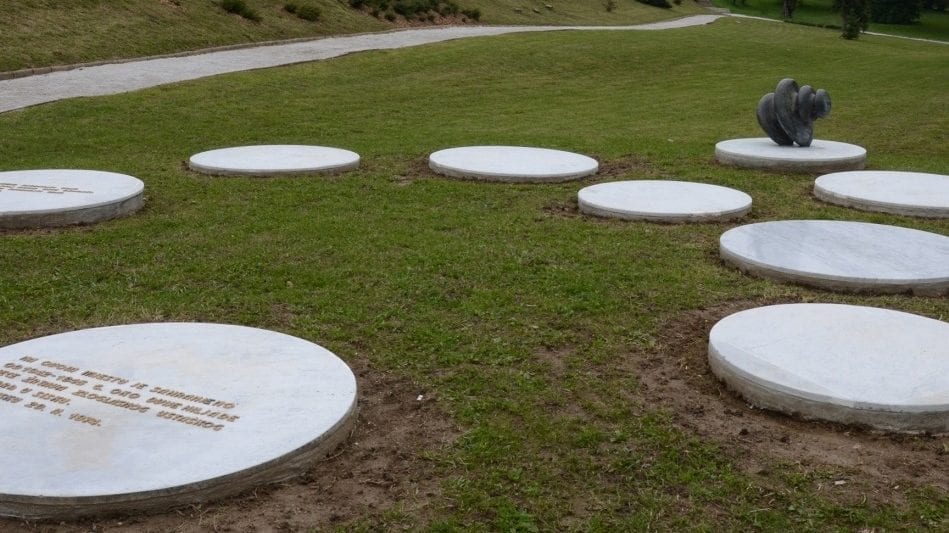
On the occasion of a commemoration organized by the Serb National Council (SNV) in the Diana Budisavljević Park in Sisak, the article reports parts of a speech by the SNV president Boris Milošević with pronounced detachment: “The SNV president Boris Milošević put forward the thesis that in Sisak in 1942 there existed a children’s camp, formally called the ‘Shelter for Refugee Children.’ During the summer, he stated, more than 2,000 children were housed there, mostly from Kozara and from the camps Mlaka, Jablanac, and Košutarica. Milošević said that the children were transported in freight wagons for cattle and that the Ustaša forcibly separated them from parents who had been killed or sent to forced labor. He also stated that in August 1942, 515 children died in the camp, and that a total of 1,152 allegedly perished during its operation. He spoke as well of alleged visits by Ustaša commanders such as Maks Luburić and Ljubo Miloš, claiming that during these visits children were violently separated from their mothers. In his speech, Milošević asserted that there was no care for the children in the camp, that they lay on dirty straw, hungry and neglected, despite the alleged presence of food in storage facilities. It was particularly emphasized that the children were saved thanks to the action of Diana Budisavljević, with the help of teacher Ante Dumbović and the local population, who allegedly took them in.”
Following this, the article advances the controversial thesis that “there is no scientific evidence whatsoever that a children’s camp existed in Sisak.” According to the portal, during 1942 and 1943 a Children’s Shelter operated in Sisak, “established in response to extremely difficult wartime and social circumstances, especially after the large wave of refugees from the Kozara area.”
In support of this claim, the article refers to historian Vlatka Vukelić, who states that during the Second World War there was no children’s camp in Sisak, but rather a children’s shelter under the jurisdiction of the then Ministry of Social Affairs of the NDH, “which in today’s terms would correspond to a ministry of social welfare.” Vukelić emphasizes that a real camp would have had to be under military or police administration, like Jasenovac, and that for Sisak there are allegedly no data indicating such a form of control.
However, relevant scholarly and historiographical literature presents a different picture.
Although official NDH documents used the designation “Shelter for Refugee Children,” scholarly analysis of the institution’s operation shows that its administrative name cannot be taken as evidence of its true nature, especially in the context of the repressive system of the NDH. Historian Nataša Mataušić explicitly rejects such an interpretation in her scholarly work The operation of the Shelter for Refugees Children in Sisak and the Activities of Teacher Ante Dumbović. In the same study, Mataušić documents that on 3 August 1942 the NDH Ministry of Social Affairs established the so-called shelter, and that during August 2,272 children were sent to Sisak, brought from Ustaša collection camps in Mlaka, Jablanac, and Košutarica. The children were accommodated at several locations in the city, without freedom of movement, and the institution functioned in direct connection with the broader NDH camp system. At the same time, the “shelter” also housed children from the Sisak Collection Camp whose parents were sent to forced labor in countries of the Third Reich. Due to the lack of adequate care, 1,152 children died there within a very short period of time, Mataušić states. “Based on original archival material from the Croatian State Archives in Zagreb and the Museum of Genocide Victims in Belgrade, as well as available professional and scholarly literature, the operation of this shelter has been reconstructed, which – without quotation marks – can be called a children’s camp,” Nataša Mataušić writes.
The historical framework within which the Sisak “Shelter for Refugee Children” should be examined is elaborated in detail by historian Narcisa Lengel-Krizman in her study Collection Camps and Children´s Holding Facilities in Northwestern Croatia 1941.-1942. The author analyzes the system of separating children after large military operations and shows that special facilities were established for children from Kozara and other areas, which in documents were often recorded as “children’s homes” or “shelters.” Lengel-Krizman warns that such administrative labels did not reflect the actual function of these institutions, but served to conceal their role within the repressive system of the NDH. According to her analysis, these children’s holding facilities were directly linked to the prior imprisonment of parents in camps and to the forced separation of children, which constitutes a key circumstance for understanding their status and the conditions in which the children were held.
A similar conclusion emerges from the work of historian Zdravko Dizdar, Camps in Northwest Croatia during the Second World War 1941.-1945. He provides a detailed description of the Sisak Children’s Camp, established on 3 August 1942 with the arrival of the first transport of children from the Mlaka camp. Dizdar notes that transports of children from Stara Gradiška, Prijedor, and Jasenovac soon followed, and that during August and September 1942 approximately 2,000 children were housed in the children’s camp, while by the end of September their number reached approximately 4,722. Dizdar explicitly states that the name Shelter for Refugee Children “was merely camouflage for the public.” He describes in detail the extremely harsh housing, hygienic, nutritional, and health conditions, epidemics of typhus, scarlet fever, and dysentery, and notes that the camp was enclosed by high barbed wire and guarded by Ustaša guards. Because of the scale of suffering, Dizdar characterizes the Sisak children’s camp as “the most horrific of all Sisak camps and one of the most horrific Ustaša camps during the war.”
It is also important to emphasize the broader interpretative framework offered by historian Ivo Goldstein. In his books The Holocaust in Zagreb (2001) and Jasenovac and Bleiburg Are Not the Same (2011), Goldstein warns that a camp is not defined exclusively by planned executions or formal military-police administration. The key criteria are the function of confinement, forced accommodation, restriction of freedom, and the consequences such conditions have for the detainees. Mass death due to hunger, disease, lack of hygiene, and exhaustion, Goldstein argues, represents a form of victimization for which responsibility lies with the regime that established and maintained such conditions, even when there was no explicit order for liquidation.
The claim that “there is no scientific evidence whatsoever” of the existence of a children’s camp in Sisak is therefore incorrect. On the contrary, numerous authors in Croatian and regional historiography explicitly identify Sisak as part of the NDH camp system.
In conclusion, although the term “Shelter for Refugee Children” is historically accurate as an administrative designation of the NDH, relevant historiography demonstrates that this institution, by its characteristics, function, and consequences, was a children’s camp within the NDH camp system. Claims that deny the existence of a children’s camp in Sisak or portray it as political manipulation do not arise from historiographical consensus, but from selective use of sources and the neglect of key scholarly works.
Funded by the European Union – NextGenerationEU.
Views and opinions expressed are however those of the author(s) only and do not necessarily reflect those of the European Union or the European Commission, nor the positions of the Agency for Electronic Media. Neither the European Union nor the European Commission, nor the Agency for Electronic Media can be held responsible for them.
This post is also available in: Hrvatski