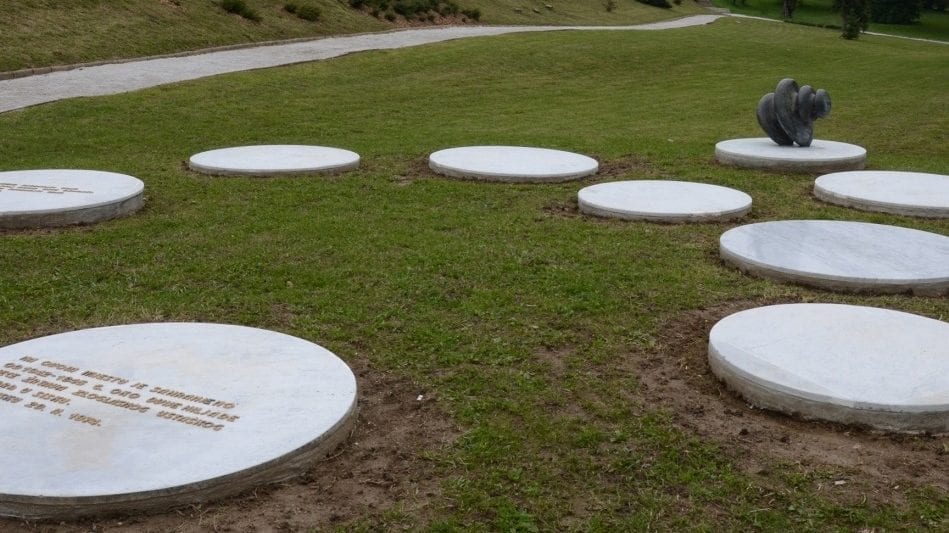
The Association of Veterans of the Homeland War and Anti-Fascists VeDRA from Split announced that on Monday, November 17, the day before the commemoration of the Remembrance Day for the Victims of Vukovar, they would throw a wreath into the Danube “in memory of Vukovar citizens of Serbian nationality, civilians who were innocently killed during 1991.” However, due to protests by war veterans who opposed this action, the association’s representatives abandoned the plan. Among the gathered veterans was also MP Stipo Mlinarić of the Homeland Movement, who stated on that occasion that in Vukovar “no Serbian victims occurred” and that “no one was killed there except Croats.”
“No Serbian victims occurred here, nor was anyone killed except Croats, where the massacre took place on the 17th, 18th, 19. 19th, and 20th here in Vukovar. Their attempt to equate victim and aggressor will not pass,” he said. (available here, archived here)
Since MP Mlinarić’s statement that “there were no Serbian victims” denies documented civilian casualties and promotes selective memory that deepens interethnic divisions, it is important to verify and correct it to prevent further dissemination of false claims about civilian suffering and to preserve respect for the victims and their families.
Available data from state institutions, human rights organizations, researchers, and archives show that numerous killings and disappearances of Serbian civilians occurred in Vukovar in 1991, and that these cases are part of the city’s overall wartime suffering.
Although the Croatian judiciary has not yet issued any verdicts for the killings and disappearances of Serbs in Vukovar during 1991 — a fact highlighted by Documenta, the center for confronting the past, in its most recent report on monitoring war crimes trials — the victims are documented. Documenta notes that “investigations are still being conducted regarding crimes committed against Serbs in Vukovar, from late spring and summer 1991 until the fall of Vukovar, within the framework of the so-called preliminary proceedings.” (available here)
The State Attorney’s Office of the Republic of Croatia (DORH) confirmed in 2018 in response to a query from Tportal (available
The Croatian Helsinki Committee for Human Rights (HHO) provided lists of persons of Serbian nationality who, according to statements from witnesses and families, disappeared in Vukovar in the spring and summer of 1991 to the State Attorney’s Office in late 1995, and again in the early 2000s. The investigation officially began in November 2002, according to then-HHO president Žarko Puhovski (available here, archived here).
Overall estimates of the number of Serbian civilian victims in Vukovar in 1991 vary by source. The Serb National Council (SNV), the umbrella organization for the Serbian national minority in Croatia, maintains a publicly available database of war crimes against Serbs. In the publication “War Crimes Against Serbs in Croatia 1991–95” (available here), SNV also published a nominal list of victims, providing full names, dates of abduction or death, and circumstances of disappearance, covering the period from June 1991 to summer 1992. The publication states: “Here we list some of the names of Serbian victims in Vukovar for whom it can be stated with high certainty that they were victims of killings and similar suffering,” listing 114 individuals. SNV notes that the total number of Serbian victims who were killed or subjected to some form of abuse in the Vukovar area during the war has not been fully determined, but estimates of the number of killed civilians of Serbian nationality range “from several dozen to more than 120.”
In addition to official and research sources, the media over the past three decades have documented numerous specific cases of killed or missing Serbian civilians in Vukovar, as well as numerous testimonies (examples available here, here, here, here, here, here, and here).
The claim by MP Stipo Mlinarić that “there were no Serbian victims” in Vukovar does not correspond to historical facts. The existence of Serbian civilians who were killed or disappeared in Vukovar in 1991 is confirmed in the nominal lists of the SNV, in Croatian Helsinki Committee documentation, and in cases handled by DORH.
Denying the existence of these victims distorts the historical record, devalues the suffering of the victims’ families, and hinders efforts to build trust in the region.
Funded by the European Union – NextGenerationEU.
Views and opinions expressed are however those of the author(s) only and do not necessarily reflect those of the European Union or the European Commission, nor the positions of the Agency for Electronic Media. Neither the European Union nor the European Commission, nor the Agency for Electronic Media can be held responsible for them.
This post is also available in: Hrvatski