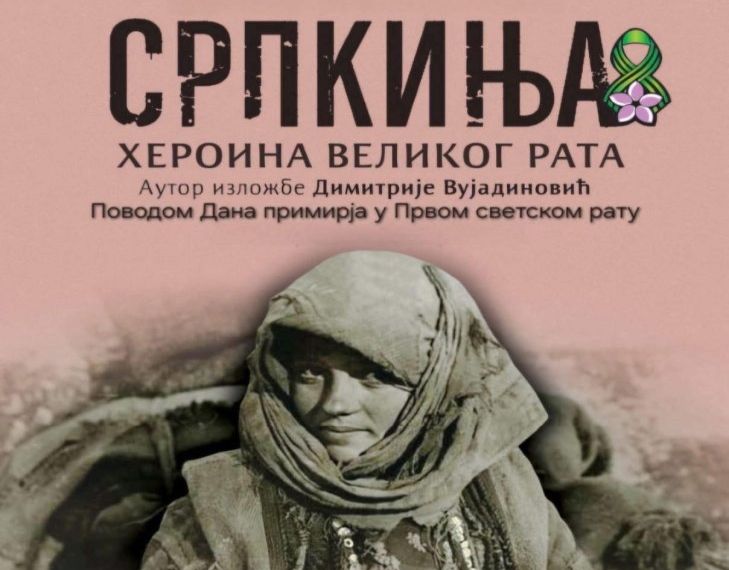
Amid intensified public debates regarding recent events organized by members of the Serbian community in Croatia, several media portals and social media profiles in recent weeks have linked the visual identity of the exhibition “Serbian Woman, Heroine of the Great War”, which was scheduled to be held at the Serbian Cultural Center in Vukovar, with a symbol allegedly bearing war-propagandistic meaning or functioning as a provocation. The supposedly contentious element was a “flower symbol” on the exhibition poster, which the authors of these claims identified as identical to the brooch worn by Hague convict Ratko Mladić on his lapel during the hearing in which he was sentenced to life imprisonment for committing war crimes. In addition to portals such as Narod.hr (available here, archived here), Direktno.hr (available here, archived here), and Maxportal (available here, archived here), the same claim also spread across social media, including through the Facebook page “Kolinda Grabar Kitarović – naša predsjednica” (available here, archived here) where the post was shared more than 470 times.
During periods of heightened sensitivity surrounding cultural events organized by the Serbian minority in Croatia – including cases of cancellations or public disputes – individual posts on social networks and portals can gain disproportionate traction and influence public perception of minority activities. Because inaccurate or unverified claims about the meaning of symbols can easily spread in such contexts and further strain interethnic relations, verifying these claims is essential to understanding the true origin and use of the symbol in question.
Available information on the symbolism, historical origins, and official use of the depicted motif provides no indication that this floral ornament carries a war-propagandistic meaning or is connected to aggression, ethnic tension, or religious intolerance. On the contrary, in practice it is associated exclusively with commemorations of events from the First World War.
First, it is necessary to establish that the flower shown in the ornament is Natalie’s Ramonda (Ramonda nathaliae[1]). This plant from the Gesneriaceae family, also known locally as the “little cake” or “phoenix flower”[2] is native to the central Balkans, with the greatest concentration found in Šumadija and southern Serbia, gradually decreasing in prevalence westward into Macedonia and south toward Greece’s Epirus region and the Aegean Sea[3]. As it is endemic to this region, it is not surprising that the earliest botanical records and classification within Carl Linnaeus’ system were made in Serbia[4]. This work was carried out by one of the most significant Serbian botanists, Josif Pančić (1814–1888), the first president of the Serbian Royal Academy. After being alerted to the plant’s distinct characteristics by Sava Petrović (1839–1898), the royal court physician to King Milan Obrenović (1854–1901), Pančić confirmed scientifically in the 1880s that it represented a separate species within the Ramonda genus. Its name was then assigned, at Petrović’s proposal, in honor of Queen Natalie Obrenović (1859–1941), despite Pančić’s initial intention to name it after the city of Niš[5].
Due to its rarity and geographical specificity to Serbian lands, its association with a queen often described as “the most beautiful lady of the 19th century”[6] and remembered for her tragic fate[7], and even more so because it was among the last subjects of interest studied by the renowned scientist Pančić[8] before his death, the flower Natalie’s Ramonda quickly became one of the national symbols of Serbs and Serbia. It is worth noting, however, that this is not an “endemic” Serbian practice: nations across the world have historically adopted various plants as national symbols — for instance, the golden wattle (Acacia pycnantha) in Australia[9], the king protea (Protea cynaroides) in South Africa[10], and the Chilean bellflower (Lapageria rosea) in Chile[11]. Some well-known examples involve plants that are endemic to broader regions spanning multiple countries but are most abundant in one, such as the Lebanese cedar[12] or the edelweiss in Austria. [13]
Regarding the specific symbol of Natalie’s Ramonda — today classified as a severely endangered and “strictly protected species”[14] in Serbia — its association with Serbian national motifs is linked primarily to the First World War, which is also the theme of the postponed Vukovar exhibition “Serbian Woman.” This connection is largely due to the plant’s abundance on Kajmakčalan[15], the site of decisive battles between the forces of Serbian Field Marshal Živojin Mišić (1855–1921) and the Bulgarian army, battles that were crucial for breaking through the Salonika Front and liberating Serbia. Moreover, the symbolism of the plant as a “phoenix flower,” capable of reviving after completely drying out once moisture returns, is often interpreted in Serbian collective memory as a metaphor for Serbia’s endurance and renewal during and after the First World War.
The specific design featuring this flower — the one seen on the exhibition poster — was introduced to the Serbian public in 2012 by the current Minister of Foreign Affairs Marko Đurić and Serbian Ambassador to Brazil Aleksandar Ristić[16], after Armistice Day (11 November) was declared a national holiday in Serbia (previously marked only as a memorial day). Commemorating this date, which marks the 1918 armistice, is not unique to Serbia; it is also officially observed as Remembrance Day in the United Kingdom and Commonwealth countries, France, and Belgium, as well as Veterans Day[17] in the United States. In the 2012 emblem, the Ramonda flower is accompanied by a green-and-black ribbon from the Albanian Commemorative Medal, awarded in memory of the 1915 retreat of the Serbian army through Albania (commonly abbreviated as the Albanian Commemorative Medal)[18]. As officially stated, the design was inspired by the established remembrance poppy symbol[19] widely used in the UK and Commonwealth to honor soldiers who fell in the First World War.
The identical design featuring the Ramonda and the Albanian Commemorative Medal ribbon has been frequently used in Serbia since 2012, almost exclusively in connection with commemorations related to the First World War. Numerous photographs show Serbian officials [20] wearing the same symbol on their lapels for these purposes. Therefore, although it is unclear why Ratko Mladić wore the same motif in the Hague courtroom, the available facts show that the symbol is not associated in Serbian public or official practice with the war in Bosnia and Herzegovina, but exclusively with First World War remembrance.
At a time of heightened sensitivity surrounding events involving the Serbian minority, accurate interpretation of symbols is essential to preventing further misunderstandings. Verified facts confirm that the Ramonda symbol is formally and publicly tied to First World War commemorations and has no basis for interpretation within the context of the 1990s conflicts. It follows that claims of its alleged provocativeness due to its association with Ratko Mladić are unsupported by facts.
[1] Ramonda nathaliae. Royal Botanic Garden – Plants of the World Online. https://powo.science.kew.org/taxon/382352-1 (accessed November 25, 2025).
[2] Blečić, Petar. “A Drop of Water Brings Them Back to Life.” Blic.rs. https://www.blic.rs/vesti/reportaza/kap-vode-ih-vraca-u-zivot/7evz71h (accessed November 25, 2025).
[3] Ramonda nathaliae. Royal Botanic Garden – Plants of the World Online. https://powo.science.kew.org/taxon/382352-1 (accessed November 25, 2025).
[4] Babani, Fatbardha. „Ecophysiological differences between poikilohydric plants Ramonda serbica and Ramonda nathaliae“. in: 5th International Symposium of Ecologists in Montenegro (2020). https://www.academia.edu/20993117/Ecophysiological_differences_between_poikilohydric_plants_Ramonda_serbica_and_Ramonda_nathaliae (accessed 25.11.2025)
[5] „Ramonda nathalia“. pancic.rs. https://pancic.bio.bg.ac.rs/Yu/Nomen/pages/129.html (accessed 25.11.2025)
[6] Jovanović, Slobodan. Vlada Milana Obrenovića (Beograd, 1926). 73.
[7] Ibid. 91.
[8] According to: pancic.rs. https://pancic.bio.bg.ac.rs (accessed 25.11.2025.)
[9] According to: https://www.botanicgardens.org.au/discover-and-learn/horticulture-and-history/what-australias-national-flower (accessed 25.11.2025.)
[10] According to: https://www.southafrica-usa.net/consulate/protea.html (accessed 25.11.2025.)
[11] According to: https://blogpatagonia.australis.com/chilean-bellflower-10-facts/ (accessed 25.11.2025.)
[12] According to: https://www.plantea.com.hr/libanonski-cedar/ (accessed 25.11.2025.)
[13] According to: https://hr.absolutviajes.com/%C5%A0vajcarska/edelweiss-%C5%A1vicarski-nacionalni-cvijet/ (accessed 25.11.2025.)
[14] Gligorović, Slavica. “How and Why Orchids, Ramonda, Lincura… Are Protected.” RTS. https://www.rts.rs/lat/magazin/priroda/5691720/flora-srbija-biodiverzitet-izlozba-miris-prirode-sanu.html (accessed November 25, 2025).
[15] “What is Ramonda?” Istorijski zabavnik. https://www.istorijskizabavnik.rs/blog/sta-je-ramonda (accessed November 25, 2025).
[16] “Natalie’s Ramonda.” Permanent Mission of the Republic of Serbia to the OSCE and Other International Organizations in Vienna. https://osce-vienna.mfa.gov.rs/lat/mediji/aktivnosti/natalijina-ramonda-simbol-obelezavanja-dana-primirja-u-republici-srbiji (accessed November 25, 2025).
[17] Fidler, Matt. “Remembrance Day Around the World.” The Guardian. https://www.theguardian.com/uk-news/gallery/2016/nov/11/remembrance-day-armistice-around-the-world-in-pictures (accessed November 25, 2025).
[18] Savić, Vanja. “History of Serbian Decorations.” https://web.archive.org/web/20110108090725/http://www.jat.com/active/sr-latin/home/main_menu/travel_info/jat_review/februar_2008/srpska_odlikovanja.html (accessed November 25, 2025).
[19] „The Poppy“. Royal British Legion. https://www.britishlegion.org.uk/get-involved/remembrance/the-poppy (accessed 25.11.2025.)
[20] For example, Aleksandar Vučić (https://www.kurir.rs/vesti/politika/3806775/aleksandar-vucic-natalijina-ramonda – pristup 25.11.2025), Ana Brnabić (https://glossy.espreso.co.rs/zdravi-i-srecni/put-do-srece/222857/sta-je-sta-simbolizuje-natalijina-ramonda – pristup 25.22.2025) and others (https://nova.rs/magazin/lifestyle/tajna-natalijine-ramonde-znacka-koju-poslanici-nose-u-skupstini/ – accessed 25.11.2025.)
Funded by the European Union – NextGenerationEU.
Views and opinions expressed are however those of the author(s) only and do not necessarily reflect those of the European Union or the European Commission, nor the positions of the Agency for Electronic Media. Neither the European Union nor the European Commission, nor the Agency for Electronic Media can be held responsible for them.
This post is also available in: Hrvatski