In a recent appearance on Podcast Velebit, Slobodan Prosperov Novak, literary historian and retired university professor, alongside a number of controversial interpretations concerning the Second World War and its aftermath, extensively discussed the historical development and interrelations of the Croatian and Serbian literary languages (the episode titled “Prosperov: The Serbian language does not exist – Serbs speak Croatian” is available here).
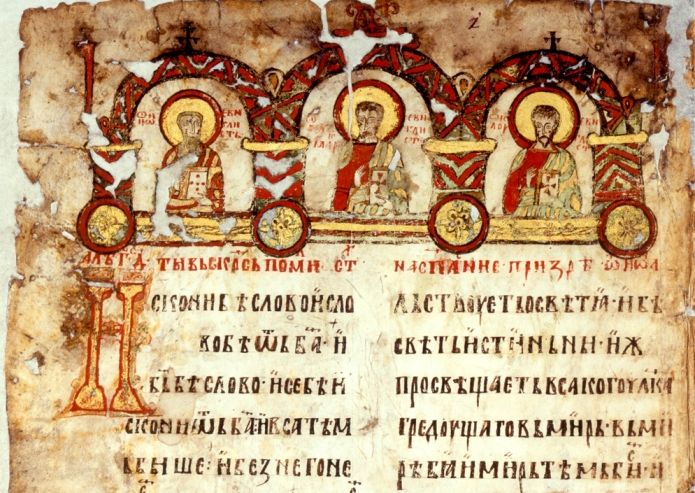
During the discussion, Prosperov Novak made several claims about the history of language, presenting them as undisputed and widely known facts, even though they differ from the conclusions of mainstream historiography and philology. One such claim concerns the Miroslav Gospel, a famous illuminated manuscript from the 12th century. Novak stated:
“The Miroslav Gospel is not a Serbian codex at all; it is a Croatian codex created in the territory of today’s Croatia, around Ston, and it has nothing to do with the Serbs. The fact that it is called Miroslav’s is purely coincidental — it was merely in that man’s possession, and later, in Hilandar, it was given to a Serbian minister, who then gave it to the Russians to publish.”
He further added that the Serbs claim their literature begins with this work, although, in his words, it is “a stolen Croatian gospel.” (available here 13:46–14:31)
However, relevant literature on this subject provides information entirely contrary to that presented by Prosperov Novak.
Firstly, within the text of the Gospel itself — on its final, 181st folio — there are details about the circumstances of its creation,
Therefore, contrary to Novak’s assertion, the Gospel did not happen to be in Prince Miroslav’s possession by chance; it was created at his commission. Likewise, the claim that it was written near Ston — that is, in present-day Croatia — rather than in present-day Montenegro, has no credible basis. More importantly, Miroslav’s rule over Hum was marked by joint diplomatic and military campaigns with his brother Stefan Nemanja,[7] who in the second half of the 12th century expanded his territory westward to the Adriatic coast, surrounding the city of Dubrovnik. During this period, the lands of Nemanja and Miroslav functioned practically as a unified political entity
Novak’s attempt to link the Gospel with Ston likely stems from the fact that Ston — specifically the Monastery of the Virgin Mary of Ston — long served as the seat of the Diocese of Hum, until the mid-13th century when the episcopal seat was moved to the Church of Sts. Peter and Paul in Bijelo Polje, where the Miroslav Gospel was still being kept.[10] Although it is not entirely clear when the Gospel was transferred from Bijelo Polje to the Hilandar Monastery,[11] there are no records indicating that it was taken unlawfully or by force — certainly not “stolen from the Croats by the Serbs.” From the 19th century onward, when the manuscript’s cultural value was first recognized and it began to be studied systematically, the Miroslav Gospel changed hands several times, but it was never stolen,[12] Until roughly two decades ago, it had not been a subject of interest in either Croatian diplomacy or Croatian scholarship.
In conclusion, Slobodan Prosperov Novak’s claim that the Miroslav Gospel is “a Croatian codex created in the territory of present-day Croatia, around Ston” is not based on historical fact and lacks any foundation in relevant historiographical and philological literature.
[1] Original and transcribed text of the Gospel available at: https://milos.io/miroslavljevo-jevandelje-u-pdf-u-i-minijature/ (accessed 26 Oct 2025).
[2] For the history of the Nemanjić family and their ancestors, see: Bogdanović, Dimitrije (ed.). Sveti Sava: Collected Works (Belgrade: Prosveta, 1986); Andrejić, Živojin. “Older and More Recent Searches for the Origins of Grand Župan Stefan Nemanja and the Complete Reversal with New Results” (in: Mythological Collection 21 – 2009): 131–170; and Marjanović-Dušanić, Smilja. “Ruler’s Symbols of Stefan Nemanja” (in: Stefan Nemanja – Saint Simeon the Myrrh-Streaming: History and Tradition – 2000): 77–87.
[3] See also: Kovačević, Jovan. “On the Miroslav Gospel” (Istorijski časopis 2 – 1951): 90–102;
Trifunović, Đorđe. Lexicon of Medieval Serbian Literary Terms (Belgrade: Nolit, 1974);
and Mrđenović, Dušan (ed.). The Miroslav Gospel: History and Commentary (Belgrade: Dosije, 2002).
[4] According to: https://web.archive.org/web/20160305010042/http://www.narodnimuzej.rs/zanimljivosti/price-iz-srednjeg-veka/miroslavljevo-jevandjelje/ (accessed 26 Oct 2025);
https://www.unesco.org/en/memory-world/miroslav-gospel-manuscript-1180 (accessed 26 Oct 2025); and Mrđenović, Dušan (ed.). The Miroslav Gospel: History and Commentary (Belgrade: Dosije, 2002).
[5] Original and transcribed text of the Gospel available at: https://milos.io/miroslavljevo-jevandelje-u-pdf-u-i-minijature/ (accessed 26 Oct 2025).
[6] Mrđenović, Dušan (ed.). The Miroslav Gospel: History and Commentary (Belgrade: Dosije, 2002): 16.
[7] Blagojević, Miloš. Serbia in the Time of the Nemanjić Dynasty: From Principality to Empire 1168–1371 (Belgrade: Vajat, 1989): 131. 131.
[8] Bubalo, Đorđe. The Serbian Land and the Coast during the Rule of the Nemanjić Dynasty, Vol. 1 (Novi Sad: SANU, 2000) 213. and Marjanović-Dušanić, Smilja. The Ruling Ideology of the Nemanjić Dynasty: A Diplomatic Study (Belgrade: Srpska književna zadruga, 1997): 78. 78.
[9] Kalić, Jovanka. “The Struggles and Achievements of Grand Župan Stefan Nemanja.” In: History of the Serbian People, Vol. 1 (Belgrade: Srpska književna zadruga, 1981): 251–262. 251-262.
[10] See in more detail: Blagojević, Miloš. The Diocese and Metropolis of Zahumlje and Herzegovina from Its Foundation to the End of the 19th Century (Belgrade: Svet knjige, 2009).
[11] For further details, see: Mrđenović, Dušan (ed.). The Miroslav Gospel: History and Commentary (Belgrade: Dosije, 2002).
[12] See further in: ibid.; and https://web.archive.org/web/20170731100925/http://lat.rtrs.tv/vijesti/vijest.php?id=70839 (accessed 26 Oct 2025).
Funded by the European Union – NextGenerationEU.
Views and opinions expressed are however those of the author(s) only and do not necessarily reflect those of the European Union or the European Commission, nor the positions of the Agency for Electronic Media. Neither the European Union nor the European Commission, nor the Agency for Electronic Media can be held responsible for them.
This post is also available in: Hrvatski